

Why Switch To A Tankless Water Heater. Sediment buildup in conventional tanks vs. the descalable design of a tankless unit. And the real-world fuel savings in Tampa.
Read the transcript ▼
hey everybody my name's Corbin I work for Titan plumet electric and today we're going to cut open a 50 galon electric water heater and take a look at what's [Music] inside all right everybody I've cut open the 50-gon electric water heater now let's take a look at what's inside oh my my God this is horrible look at the amount of sediment inside this heater this builds up over years and years in your tanked heater and it just sits there and swirls around as you use your hot water in your home one of the best ways to prevent sediment is to just get away with the tank heater all in general and do a tankless water heater that doesn't have a tank and cannot get sediment buil up inside of it to this magnitude all right so this is a tankless water heater as you can see it's much much smaller than a tank heater these heat the water on demand as you use hot water so you don't have to have a reserve of 40 to 50 gallons in a tanked heater where that sediment can build up the cold water comes in hot water comes out plain and simple this is an adequate replacement for a tanked water heater all right so if you're interested in a a tankless water heater opposed to a tank one that can build up sediment you should give Titan Plumbing electric a call at 813 93381 or visit our website Titan plumbing and electric.com
Tankless Water Heater Installation in Tampa
Tankless water heater installation in Tampa is a bigger job than swapping one tank for another. A tank needs a water connection, a fuel source, and a spot on the floor. A tankless unit needs more gas or more amperage than most Tampa houses were built with, a vent or an outdoor-rated cabinet, a way to flush out scale, and a size that matches how many showers your house runs at once.
We are a licensed plumbing contractor (CFC1430231) and a licensed electrical contractor (EC13012958) under one roof, family-owned in Tampa since 1994. That matters on tankless jobs, because the gas line and the electrical panel cause more trouble than the heater itself, and here the same crew owns all three.
Where a Tankless Unit Goes in a Tampa House
Most Tampa houses put the water heater in one of three places, and each one changes the install.
- Garage: the easiest spot. There is wall space, the gas or electric service is usually close, and venting out through the wall is short. Plenty of older Tampa block homes already have the tank here.
- Interior closet or utility room: common in slab homes where the tank sits in a hall closet. Gas units here need a vent run through the wall or roof, and condensing units need a drain for the condensate. Electric units are often simpler in a closet because there is nothing to vent.
- Exterior wall: Florida rarely freezes hard, so outdoor-rated gas models mounted on the outside of the house are a common choice. There is no vent pipe through the house, and the closet or garage space comes back to you. We still protect the water lines from the occasional cold snap and keep the unit clear of sprinkler spray.
Sizing a Tankless Water Heater for Tampa Water
A tankless heater is sized by two numbers: how many gallons per minute of hot water you use at the busiest moment, and how many degrees the unit has to raise the water. Square footage tells you very little.
Start with flow. A modern showerhead is capped at 2.5 gallons per minute by federal standard, and many run closer to 2.0. Two showers and a kitchen faucet running together can push past 6 gallons per minute. Then the temperature rise: if water comes in at around 70 degrees and you want 120 at the tap, the unit has to add 50 degrees to every gallon. Tampa has an advantage here, because our incoming water is much warmer than in northern states, so the same unit delivers more flow. It still drops a little in January, and we size for that week, not for August.
A unit that is too small runs lukewarm when two people shower. A unit that is too big costs more than it should and, on the electric side, can demand more amperage than your panel can spare. We count your fixtures, ask how your family actually uses hot water, and size from that.
Gas Tankless Installation, Gas Lines, and Venting
A typical gas tank burns around 40,000 BTU per hour. A whole-house gas tankless unit can burn four to five times that at full fire. The half-inch gas line that fed your old tank is often too small to deliver it, and an undersized line is the most common reason a new tankless unit throws ignition errors or runs cold under load. We check the meter, the length of the run, and every other gas appliance on the line, and we upsize the pipe when the numbers call for it.
Venting depends on the unit. Non-condensing models vent hot exhaust through stainless or special-rated pipe. Condensing models are more efficient and can vent through PVC, but they produce acidic condensate that has to go to a drain, usually through a neutralizer so it does not eat at cast iron drain lines common in older Tampa homes. Outdoor models skip the vent pipe entirely. If your house has propane instead of natural gas, the same rules apply with a different gas valve and different line sizing.
Electric Tankless and Your Electrical Panel
Electric tankless units are simple on the plumbing side and demanding on the electrical side. A whole-house electric model heats water instantly with heavy elements, and that takes a lot of current. As an example of the math, a 27 kW unit at 240 volts draws about 112 amps when it runs flat out, usually split across two or three dedicated double-pole breakers and heavy-gauge wire. A tank heater, by comparison, sits on a single 30-amp circuit.
Many Tampa houses built before the 1980s still have 100-amp or 150-amp service, and some have Federal Pacific or Zinsco panels that should not take on new load at all. Before we quote an electric unit, one of our electricians looks at the panel, the service size, and your existing load (AC, range, dryer, pool pump, EV charger). If the panel needs an upgrade, it goes into the same quote and the same permit. Plumbing-only companies have to hire out that part.
If you want electric, the Optimal tankless line we install is the premium option, with 99 percent efficiency and a 25-year residential warranty. It has its own page with the details.
Tampa Hard Water, Descaling Valves, and Softeners
Tampa water runs about 7 to 10 grains per gallon of hardness. In a tankless unit, those minerals land on the heat exchanger, the hottest surface in the house, and build up as scale. Scale cuts flow, causes temperature swings, triggers error codes, and shortens the life of the unit.
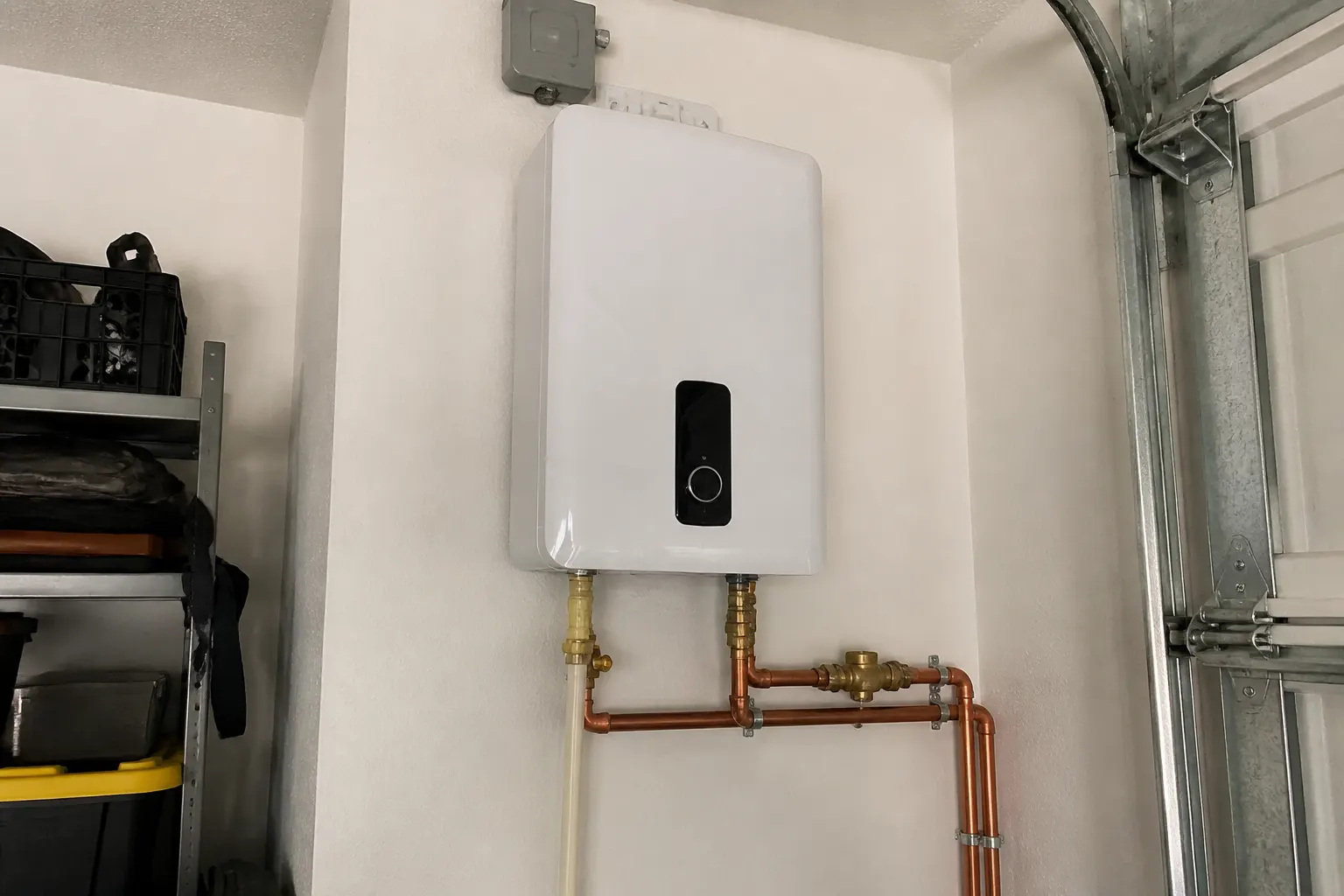
Every tankless water heater installation we do in Tampa includes isolation valves with service ports on the hot and cold lines. Those valves let us hook up a pump and run descaling solution through the heat exchanger without cutting pipe. Most manufacturers call for a flush about once a year; in harder water, or a busy household, we may suggest more often.
A whole-house water softener ahead of the heater cuts scale at the source and helps every fixture in the house. Some homeowners add a scale-reduction cartridge instead. We will tell you which makes sense for your water and budget.

Permits for Tankless Water Heater Installation in Tampa
A tankless install in Tampa needs a permit. Depending on where you live, that comes from the City of Tampa, Hillsborough County, Pinellas County or your city in Pinellas, or Pasco County. Gas work, venting, and new electrical circuits all fall under it, and an inspector checks the work before the permit is closed.
We pull the permit, schedule the inspection, and close it out. A permitted install protects your manufacturer warranty, keeps your homeowner's insurance on solid ground, and saves you a problem when you sell the house.
Recirculation and Waiting for Hot Water
A tankless unit makes hot water on demand, but it cannot make the pipe between the heater and your shower any shorter. In a long ranch house with the heater in the garage and the master bath at the far end, you may wait about as long for hot water as you did with a tank, sometimes a little longer while the burner fires.
Recirculation fixes that. Some gas tankless models have a built-in recirculation pump that keeps hot water near the fixtures on a schedule or on demand. In houses without a dedicated return line, a crossover valve under the farthest sink can do the same job using the cold line. We will tell you whether your layout needs it before you pay for it.
What Happens on Install Day
A straight tank-to-tankless swap with no major gas or panel changes is usually a one-day job. Adding a new gas run, a panel upgrade, or moving the heater to an exterior wall can stretch it. Here is the order of a typical day:
- Shut off water and gas or power, then drain the old tank.
- Disconnect the old tank and take it out of the house.
- Mount the tankless unit and its bracket on the wall.
- Run or upsize the gas line, or pull the new electrical circuits from the panel.
- Install the vent and condensate drain, or confirm clearances for an outdoor unit.
- Connect water lines with isolation valves and a pressure relief valve.
- Fill, purge the air, fire the unit, and test temperature and flow at several fixtures.
- Walk you through the controls and how flushing works, then schedule the inspection.
Tankless Water Heater Repair and Maintenance in Tampa
We service tankless units whether we installed them or not. Most problems we see fall into a handful of groups: scale buildup on the heat exchanger, ignition or flame failure on gas units (often an undersized gas line or a dirty burner), venting faults, a clogged inlet filter screen, and failed flow sensors. Most units display an error code, and that code narrows the problem down fast. Write it down before you call.
A routine maintenance visit covers a descaling flush through the service valves, cleaning the inlet water filter, checking the vent and condensate drain, and testing the burner or elements. If a unit runs out of hot water, swings hot and cold, or shuts off mid-shower, scale or an undersized gas supply is the usual cause. We handle tankless water heater repair across Tampa Monday through Saturday, same-day when the schedule allows.

Tankless or a New Tank
Tankless is not the right answer for every house. A tank costs less to install, works with the gas line and circuit you already have, and keeps working through a power outage if it is gas. A tankless unit costs more up front but lasts longer, takes up a fraction of the space, and does not run out in the middle of a shower.
If your tank just failed and you need hot water tonight, a tank replacement is usually faster. If you plan to stay in the house for years, your family runs back-to-back showers, or you want the closet back, tankless tends to pay off. Our water heater replacement page covers the tank side of that decision.
Why Homeowners Call Titan for Tankless Water Heater Installation in Tampa
A tankless install touches plumbing, gas, venting, and often the electrical panel. Most companies handle one or two of those and subcontract the rest. We hold plumbing (CFC1430231), electrical (EC13012958), and general contractor (CBC057910) licenses, so one company is responsible for the whole job and one permit covers it.
We install Rheem and A.O. Smith tankless units and Optimal electric tankless, and we quote a flat rate before work starts. Our crews cover Tampa, Hillsborough, Pinellas, and Pasco, Monday through Saturday. Call (813) 933-8010 to set up a visit.
More from the field

Powering A Large Electric Tankless Water Heater. Most electric tankless units need 120-160 amps of dedicated capacity. Here is what panel and wiring upgrades that requires.
Read the transcript ▼
We have a request from a customer to put in a tankless water heater and it's a very large electric tankless heater. They want to be able to fill a tub with the tankless heater. Most people don't know what's involved in upgrading your electrical to be able to put one of these bad boys in. We're going to step over and talk to Max from Titan and he's going to show us what's involved to upgrade your service and enough power to be able to run this large electric tankless heater. All right. And what we got here is right now we had to upgrade our meter outside from a 200 amp meter to a 400 amp meter to refeed these two panels. Before that we had a 200 amp here. Now we're adding a second panel over there to have those 400 amps. So this is our splice box where we refeed our feeder wire into the first panel and then we refeed the second panel on the bottom here and come in the bottom into this panel as well. For more information on upgrading your panels and maybe putting in a tankless electric water heater, go to titanplumbinglectric.com. [Music]

Can You Install A Tankless Water Heater?. Eligibility check: gas line, electrical capacity, and venting for a tankless install.
Read the transcript ▼
questions we get asked is can we install a tankless water heater in place of a standard tanked water heater behind me you can see is a tankless gas naven water heater this is a great brand this supplies all the hot water to a house without having have the tank system so it's water on demand and there's no storage of water uh being heated and cooled off so it's much more energy efficient you also don't run out of hot water for more information on hot water heaters tankless heaters go to Titan Plumbing electric.com