
Tips To Finding The Right Generator For You. How Titan sizes a whole-house standby generator: brand selection (Briggs & Stratton, Kohler, Champion), kW sizing for your home and AC count, fuel source (natural gas vs propane), placement setbacks from property lines, windows, doors, and electrical service, plus warranty length by brand.
In this video · 6 chapters ▼
Read the transcript ▼
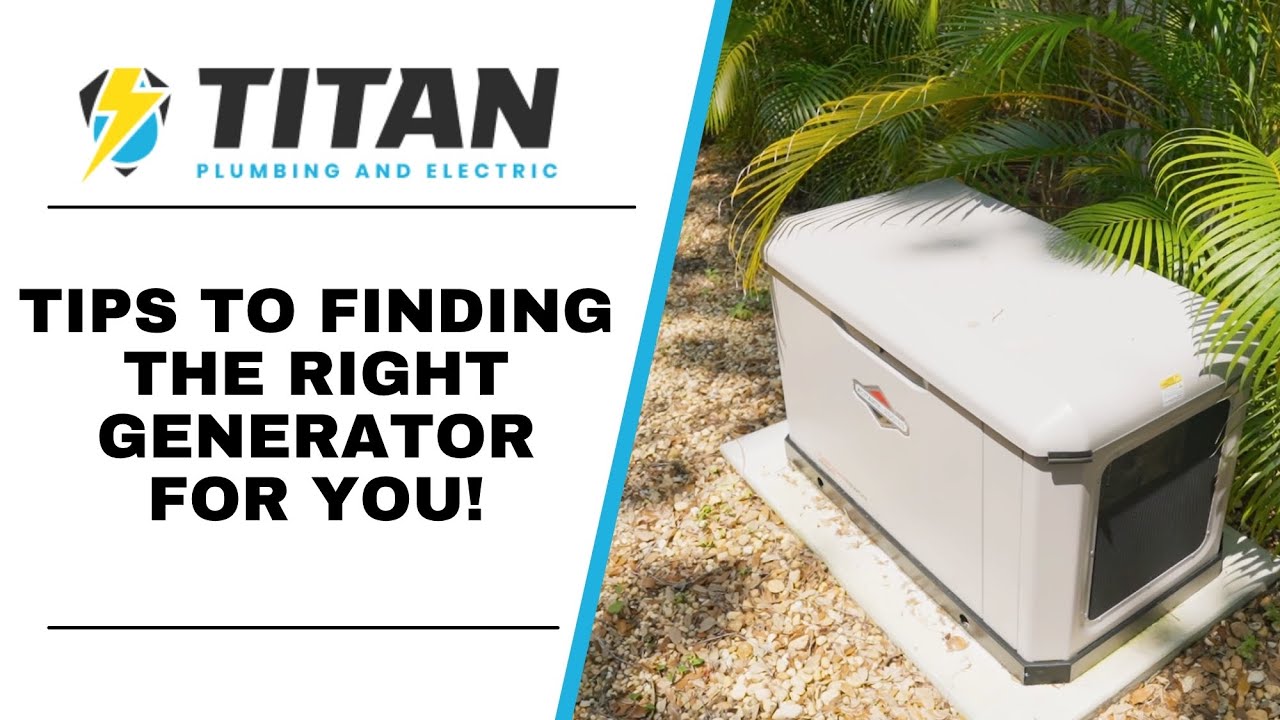
Today I want to give you some tips on purchasing a whole-house generator. As you see behind me, we have a Briggs & Stratton whole-house generator. The first thing to think about is picking the type of generator and the brand. The type would be whole-house generator. The brand would be probably a Kohler, a Briggs & Stratton, or maybe a Champion generator. The next important tip on a generator is size. The sizing of the generator goes by the size of your house and how many fixtures you have, like air-conditioner units that need to be run off this whole-house generator. Generally speaking, if your house is around 2,000 square feet or smaller and you have one air-conditioner unit, you can probably do a 22 kW generator. If your house is larger, like 2,500, maybe two air-conditioner units, somewhere up to around 4,000 or 5,000 square feet, I would go with a unit like this one, which is a 26 kW. The next important tip you want to consider is the fuel source. Generators usually run on propane or natural gas. If your home has a meter on the side of the house, you have gas coming to the house from the municipality. That's a great way to run your generator. Off of that natural gas. If you don't have natural gas, you would need to get a propane generator. One of the next important features is where the generator is going to be placed. Generally speaking, you'll be 3 ft off any property line minimum. Also, we have to figure in windows and doors. You need to be 5 ft off any windows and doors on your house. Your generator also needs to be fairly close to your electrical service because we're going to be running a service line to the generator over to your electrical panel. Plants and landscaping can also factor into your generator placement. If you have plants in front of the generator, that would be a problem if it's not easy to access, particularly on the exhaust side of the generator. They probably would die if they're closer than 5 ft to the exhaust side. When you're considering generator brands, look at the warranties. Briggs & Stratton has a 7-year warranty, Kohler has a 5-year, and a Champion generator has a 10-year warranty. For more information on generators, go to titanplumbingandelectric.com.
Tips To Finding The Right Generator For You, Tampa Whole-House Generator Walkthrough
How Titan sizes a whole-house standby generator: brand selection (Briggs & Stratton, Kohler, Champion), kW sizing for your home and AC count, fuel source (natural gas vs propane), placement setbacks from property lines, windows, doors, and electrical service, plus warranty length by brand.
Tampa Bay loses power. Hurricane season takes whole neighborhoods offline for days; lightning, transformer failures, and grid maintenance hit individual streets year-round. A whole-house standby generator runs on natural gas or LP, starts itself within seconds of an outage, and runs essentials (or the whole home, depending on size) until grid power returns. The video above gets into one of the decisions you make during sizing.
In this clip: Today I want to give you some tips on purchasing a whole-house generator.
How big a generator does a Tampa home need
Sizing is a function of square footage, AC tonnage, and which loads you actually want to run during an outage. A typical 2,000 sq ft Tampa home with one AC unit lands at a 22 kW generator. A 2,500-4,000 sq ft home with two AC units typically wants a 26 kW. Larger homes go up from there.
Natural gas or LP fuel matters too, if your meter is on the side of the house, natural gas is the easier route. If you're not on the gas grid, LP is the fallback, with a buried tank or above-ground rental.
How Titan installs a Tampa standby generator
We pull the electrical permit and the gas permit (when applicable). We confirm setbacks: 3 ft from any property line, 5 ft from any door or window, clearance for service and exhaust. We tie into the panel through an automatic transfer switch, set up the cellular monitoring on the supported brands (Generac, Kohler, Champion), and run a load test before we leave.
- 22 kW for ~2,000 sq ft / 1 AC unit; 26 kW for larger
- Natural gas or LP fuel sizing
- Setback compliance: property line, doors, windows
- Automatic transfer switch wired and load-tested
- Cellular monitoring active before we leave
In this video
6 chapters
- 0:00 Picking the brand: Briggs, Kohler, or Champion
- 0:29 Sizing for a ~2,000 sq ft home. 22 kW
- 0:59 Sizing for larger homes. 26 kW
- 1:28 Fuel source: natural gas vs. propane
- 1:58 Placement: setbacks, panel distance, landscaping
- 2:27 Warranties by brand. 5, 7, and 10 years
Key takeaways
What this video covers in plain English
Whole-house generator decisions come down to three things: sizing, fuel, and placement. The video walks one of them; here's how to think about the other two.
- 22 kW typically fits a 2,000 sq ft Tampa home with one AC unit
- Natural gas if your meter is on the side of the house; LP otherwise
- Setbacks: 3 ft from any property line, 5 ft from any door or window
- Brand warranties: Briggs 7-year, Kohler 5-year, Champion 10-year
Tampa Bay · Same-day service
Have a job like the one in the video?
Real Titan technicians, never sub-contracted. Flat-rate pricing quoted before any work begins. A+ BBB rated, family-owned since 1994.